
You loaded the towels, pressed start, and walked away. Twenty minutes later the washer is silent, the drum is full of cold water, and the display is flashing something like 5E, OE, or F8 E1. No explanation, no manual in sight, and a pile of wet laundry staring back at you.
That moment is frustrating, and it feels worse because the code looks like a secret language. Here is the good news: washer error codes are not random. Each one points to a specific system inside your machine, such as draining, filling, door locking, balance, or the electronics. Once you know which system is speaking, you can decide in a few minutes whether this is a free fix or a job for a technician.
Quick answer: A washer error code is a short message from the control board telling you which sensor or component failed its check. The letters differ by brand, but the problems are surprisingly similar. Most codes fall into five groups: drain, water supply, door lock, load balance, and electronics. This guide translates the codes for Samsung, LG, and Whirlpool so you can act fast.
Why Washer Error Codes Exist and What Your Machine Is Trying to Say
What a code actually is
Modern washers run constant self checks. The control board watches the drain pump, water level sensor, door latch, motor speed, and temperature sensor. When a reading falls outside the expected range for too long, the board stops the cycle and shows a code. Think of it as a smoke alarm. It tells you where to look, not exactly what burned.
That distinction matters. A drain code does not always mean a broken pump. A clogged filter, a kinked hose, or too much detergent can trigger the same message. Treating the code as a starting point keeps you from paying for parts you do not need.
The mindset that saves money
Most people react to a code in one of two ways. Some panic and assume the washer is finished. Others ignore it, restart the cycle five times, and let a small issue turn into a bigger one. A calmer approach works better:
- Write down the exact code and the cycle you were running.
- Check the simple causes first (power, door, hoses, filter, load).
- Reset the machine once.
- If the code returns, treat it as a real fault and stop forcing cycles.
Repeated restarts can overheat a pump or strain a door lock, which turns a $0 fix into a parts bill.
Safety comes first
Before you touch anything, unplug the washer. Water and electricity share the same small space in a laundry room. If you see smoke, smell burning, or notice water near the outlet, leave it unplugged and call a professional.
The 5 Minute Reset Routine to Try First
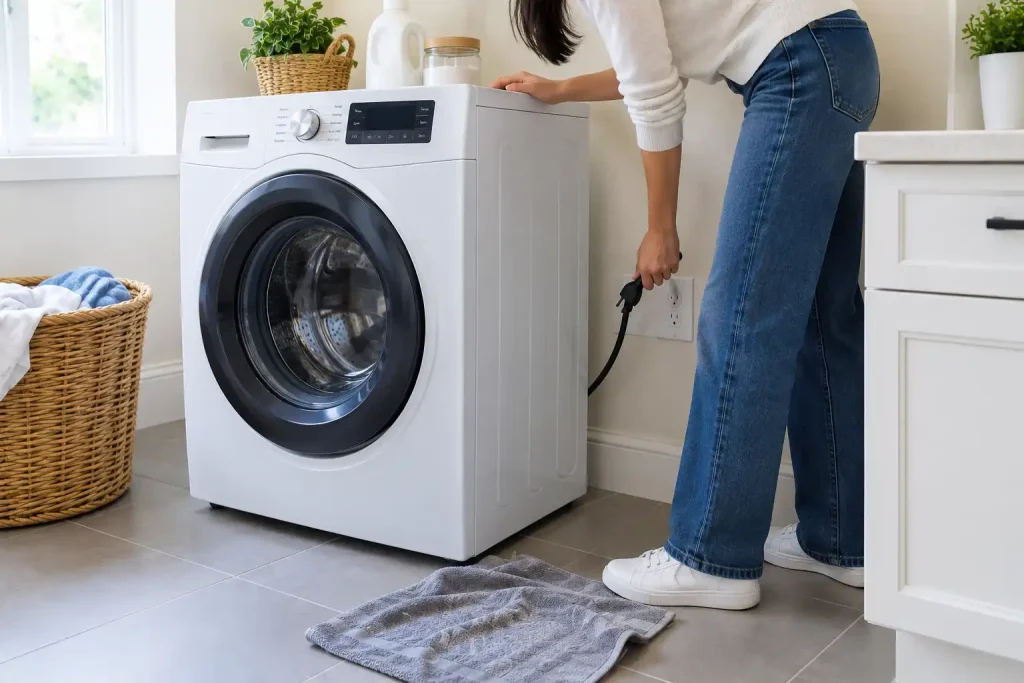
Many codes clear with a basic reset, especially after a power flicker. Abilene gets strong summer storms, and brief surges can confuse a control board even when nothing is broken. Try this sequence before you dig deeper:
- Pause and open the door. Remove any item blocking the door seal or latch.
- Unplug the washer for 2 to 3 minutes. This lets the control board fully reset.
- Check the load. Remove a few items if the drum is packed, or redistribute heavy pieces like jeans and towels.
- Look at the hoses. Make sure inlet hoses are not kinked and the faucets are fully open.
- Plug in and run a short rinse and spin cycle. If the code stays gone, you likely fixed a temporary glitch.
If the same code appears again within a cycle or two, move to the brand sections below.
Samsung Washing Machine Codes
Samsung displays codes as a mix of numbers and letters, and some models show icons or flashing lights instead. The same code can also vary slightly between front load and top load models, so always confirm with your manual on the official Samsung Support page.
| Code | What It Means | First Thing to Try |
| 5E (sometimes SE) | Washer cannot drain | Clean the drain pump filter, check the drain hose for kinks |
| 4E, 4C, or nF | Water is not filling properly | Open both faucets, straighten hoses, clean inlet screens |
| dE, dC, or dE1/dE2 | Door not closing or locking | Close firmly, inspect the latch and door seal |
| UE or UB | Unbalanced load | Redistribute items, wash heavy bulky items alone |
| LE or LC | Water leak detected | Check hoses and the area around the base for moisture |
| 1E or 1C | Water level sensor problem | Power cycle, then call a technician if it returns |
| HE or HC | Heater problem (heated wash models) | Reset once, then service if it returns |
| OE | Water level too high | Stop the cycle, drain, and check the inlet valve |
| Sud or 5UD | Too many suds | Let the suds cycle finish, use less HE detergent |
| AE | Control board communication problem | Unplug for several minutes, service if it repeats |
| tE or tC | Temperature sensor fault | Reset, then professional diagnosis |
Samsung 5E: the one people search most
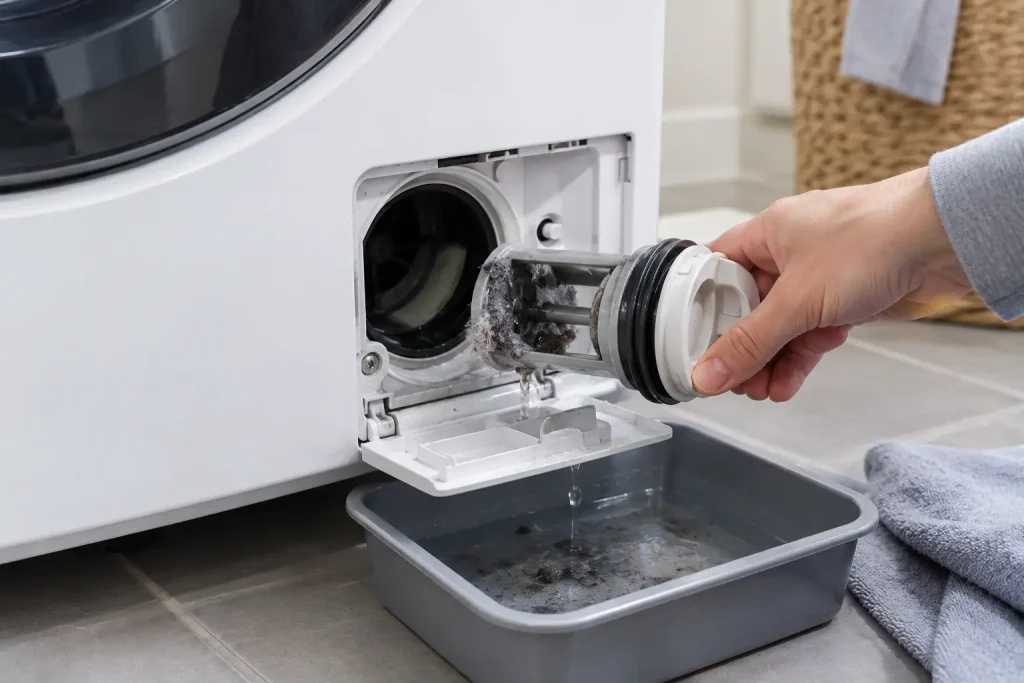
The 5E message means the washer could not push water out within the expected time. The most common culprit is a clogged drain pump filter packed with lint, coins, hair ties, and tissue. Place a shallow pan and towels under the small access panel at the bottom front, open the filter slowly, and clear it. If the filter is clean, check that the drain hose is not crushed behind the machine or pushed too far into the standpipe.
Samsung 4E and nF: fill problems
A fill code usually starts outside the washer. Confirm the faucets are open, then unscrew each inlet hose and look at the small mesh screen. Hard water minerals and sediment collect there and restrict flow. If you want to understand how local water affects appliances, read our related post, How Abilene Hard Water Impacts Your Home Appliances.
Samsung dE and the door lock
Door lock codes are common because the latch is a small electronic part that opens and closes thousands of times. If the door closes but the code keeps returning, the latch assembly or its wiring may be wearing out. That is a repair, not a reset. Brand specific parts can be tricky to source, which we cover in Samsung vs LG Appliance Repair: Why Specialized Parts Matter.
LG Washing Machine Codes
LG uses short two letter codes, and several of them end in E. They are easy to confuse, so the table below separates them clearly. You can match your model with the manual on LG Support.
| Code | What It Means | First Thing to Try |
| OE | Washer cannot drain | Clean the coin trap filter, check the drain hose |
| IE | Water inlet problem | Open faucets, check hoses and inlet screens |
| UE | Unbalanced load | Redistribute or reduce the load |
| dE, dE1, dE2, dE4 | Door open, lock, or sensor problem | Close firmly, check for trapped fabric |
| FE | Overfilling | Unplug and call a technician |
| PE | Pressure (water level) sensor error | Reset once, then service |
| LE | Motor problem | Reduce load, reset, service if it repeats |
| tE | Heating or temperature sensor error | Reset, then professional diagnosis |
| Sud or Sd | Excess suds | Wait for the foam to clear, use less detergent |
| CL | Child lock active | Hold the control lock button to release |
What does OE mean on an LG washer?
OE is the most searched LG code, and it means the washer could not drain within the allowed time. Start with the small coin trap filter at the bottom front of the machine. Look for socks, lint, and detergent sludge. Then check the drain hose for sharp bends and confirm it is not inserted too deeply into the standpipe, which can create suction that slows draining. If both are clear and OE continues, the drain pump itself may be failing.
LG UE: not always a heavy load
UE usually means the drum cannot spin evenly. A single heavy item like a comforter can bunch up and throw the drum off. Wash bulky items on their own and add a couple of towels to help balance. If UE shows up with a normal load, check that the washer sits level and that the shipping bolts (on a new installation) were removed.
LG dE and the door
LG door errors have a few versions. dE1 points to a door that is not closed, dE2 to a lock problem, and dE4 to a door sensor issue. If a quick close and reset does not help, the latch or the wire harness behind it needs inspection.
Smell plus error code? Check the drum and gasket
A washer carrying odor and recurring drain or fill codes often has residue buildup. Our maintenance guide, How to Clean a Smelly Front Load Washer, walks through gasket and drum care that prevents many of these problems.
Whirlpool Washing Machine Codes
Whirlpool codes look different depending on whether you own a front load or top load washer. Maytag washers come from the same parent company and often share similar codes, so this section helps Maytag owners too. For model specific details, the official Whirlpool owner resources are the best reference.
Whirlpool front load codes
| Code | What It Means | First Thing to Try |
| F5 E2 | Door not locking | Remove obstructions, close fully |
| F7 E1 | Motor not reaching correct speed | Check shipping bolts, reduce load |
| F8 E1 or LO FL | Low water flow | Open faucets, straighten hoses |
| F9 E1 | Slow draining | Clean the drain pump filter, check the hose |
| Sud or Sd | Too many suds | Let the rinse run, use less detergent |
| LOC or LC | Control lock on | Hold the control lock button |
| Int | Cycle paused or canceled | Wait for the drain, then press Cancel twice |
| dET | Detergent cartridge not detected | Reseat the cartridge, close the drawer |
| rL or F34 | Items found during a Clean Washer cycle | Empty the drum and restart |
Whirlpool top load codes
| Code | What It Means | First Thing to Try |
| drn | Not draining properly | Check drain hose for kinks or clogs |
| LdL | Lid not locking | Clear obstructions, clean around the lid lock |
| LdU | Object on the lid | Remove the item from the lid |
| lid | Lid left open during cycle | Close it, since the washer resets after about 10 minutes |
| HC | Hot and cold hoses swapped | Swap hoses to the matching inlets |
| LF or LO FL | Slow fill | Open faucets, check hoses |
| OL | Load too large | Remove some items |
| Ofb | Load off balance | Let the correction routine run, or redistribute |
| PF | Power failure interrupted the cycle | Press and hold Start to resume |
The F code pattern
Whirlpool front load codes follow a simple rhythm: the first part (F5, F7, F8, F9) names the system, and the second part (E1, E2) adds detail. Once you see the pattern, a code like F9 E1 stops feeling mysterious. It simply says the drain took too long.
If you are stuck on a stubborn top load or front load problem, our related article on washing machine won’t spin covers causes that often show up alongside Whirlpool codes.
Quick Reference Chart: Washer Error Codes Across Samsung, Whirlpool, and LG
This is the translation table most people are really looking for. Find the problem type, then read across to your brand.
| Problem Type | Samsung | LG | Whirlpool |
| Won’t drain | 5E | OE | F9 E1, drn |
| Won’t fill or slow fill | 4E, 4C, nF | IE | F8 E1, LO FL, LF |
| Door or lid issue | dE, dC | dE, dE1, dE2, dE4 | F5 E2, LdL, lid |
| Unbalanced load | UE, UB | UE | Ofb, OL |
| Too many suds | Sud, 5UD | Sud, Sd | Sud, Sd |
| Leak detected | LE, LC | Check for water at the base | Check hoses and pan area |
| Motor problem | 3E | LE | F7 E1 |
| Heater or temperature sensor | HE, tE | tE | Model specific |
| Electronics or board | AE | PE, FE | F codes not listed above |
Keep this chart bookmarked on your phone. It saves a surprising amount of guessing at 9 p.m. when the laundry is already soaked.
Fixes That Match the Problem
The brand name changes, but the repair logic does not. Here are the five problem families and the most practical response for each.
Drain problems (5E, OE, F9 E1, drn)
Drain issues are the most frequent reason people search for washer error codes. Work through this order:
- Unplug the washer and set towels and a shallow pan in front of it.
- Open the drain pump filter slowly and let trapped water out.
- Remove lint, coins, and debris, then rinse the filter.
- Inspect the drain hose for kinks and clogs.
- Confirm the standpipe height and insertion depth match the manual.
If the pump hums but water does not move, or the pump is silent, the pump motor needs replacement. The same drain path matters in other appliances, so if a dishwasher in your home also drains slowly, our dishwasher repair page explains how we diagnose shared plumbing issues.
Water supply problems (4E, IE, F8 E1)
Open both faucets all the way. Check hoses for kinks. Remove each hose and rinse the mesh screen on the washer inlet. If both are clear and you still get a fill code, the inlet valve may be failing or the household water pressure is too low.
Door and lid problems (dE, F5 E2, LdL)
Look for fabric caught in the seal, a bent latch, or detergent crust around the lock. Wipe the latch area with a damp cloth. If the door looks perfect and the code remains, the lock assembly is electrical and usually needs replacement.
Balance problems (UE, Ofb)
Pause the cycle, open the door, and spread the load evenly. Wash large items like blankets alone. Check that all four feet touch the floor and that the washer does not rock when you push the corners.
Suds problems (Sud, Sd, 5UD)
Too much detergent or the wrong type (non HE) creates foam that confuses the water level sensor. Run a rinse and spin to clear it, then cut your detergent amount in half for the next load. Most households use far more detergent than modern machines need.
Why Codes Keep Coming Back
If you cleared a code and it returned within a few loads, one of these patterns is usually at work. This is where many guides stop, but it is where lasting fixes begin.
- Hard water scale. Minerals coat sensors, screens, and heating elements. Abilene homes often deal with it, and the result is slow fills, false level readings, and stiff laundry.
- Detergent habits. Too much soap builds residue that triggers suds, drain, and balance codes.
- Poor leveling. A washer that rocks on a slightly uneven floor will throw balance errors again and again.
- Power quality. Surges from storms or an overloaded outlet can cause board communication faults. A dedicated outlet and a quality surge protector help.
- Aging parts. Latches, pumps, and valves wear with use. A washer in its eighth or ninth year may show repeat codes because components are reaching the end of their life.
Understanding the cause behind washer error codes keeps you from replacing the wrong part. The first fix is often cheap. The expensive mistake is ignoring the pattern.
DIY or Call a Pro? A Clear Decision Guide
Not every code deserves a service call, and not every code should be tackled with a screwdriver. Use this guide.
| Situation | DIY Friendly? | Why |
| Suds, unbalanced load, control lock, lid or door obstruction | Yes | Usually load or user related |
| Drain or fill code that clears after filter or hose cleaning | Yes | Blockage or supply issue |
| Same code returns after reset and cleaning | No | Likely a failing part |
| Burning smell, smoke, or sparks | No | Electrical safety risk |
| Water leaking from the base, repeated leak codes | No | Pump, seal, or hose failure |
| Board, motor, or heater codes (AE, F7 E1, HE, tE) | No | Needs testing equipment |
What repairs typically cost
Pricing varies by model and part availability, but these ranges give you a realistic picture. They are general estimates, not a quote.
| Repair | Typical Range |
| Cleaning and reset (no parts) | Often no parts cost |
| Drain pump replacement | $150 to $350 |
| Door lock or latch assembly | $120 to $300 |
| Water inlet valve | $120 to $250 |
| Motor or control board | $250 to $600 |
Our home page notes that most appliance repairs fall in the $100 to $500 range, and a clear estimate is shared before any work begins. If you want a diagnosis from a local technician, you can use our washing machine repair service for a full inspection.
Repair or Replace? Use the 50% Rule
If a repair quote is above half the price of a comparable new washer, replacement usually makes more financial sense, especially when the machine is past 10 years old. A relatively new washer with a single failed part is almost always worth repairing. For a full walkthrough of the math, read Repair or Replace an Appliance? How to Use the 50% Rule to Decide.
Consider three questions before deciding:
- How old is the machine?
- Is this the first major repair or the third?
- Is the part widely available for your brand?
When the answers are “under 8 years,” “first repair,” and “yes,” repair wins.
How to Prevent Error Codes Before They Start
A few habits cut error codes dramatically:
- Use HE detergent and measure it. Less is almost always enough.
- Leave the door or lid ajar after each wash so moisture escapes.
- Clean the drain pump filter every 2 to 3 months.
- Wipe the door gasket on front load machines weekly.
- Run a tub clean cycle monthly with an approved cleaner.
- Keep the washer level and a few inches away from the wall so hoses do not kink.
- Avoid overloading, and wash heavy items separately.
- Replace aging fill hoses with braided hoses every 5 years.
You can also review washer care and efficiency guidance on ENERGY STAR for settings that reduce wear while saving water.
Local Help for Abilene and Nearby Communities
If you have worked through the steps above and your washer still shows a code, a trained technician can test the pump, valve, latch, and board properly instead of guessing. Abilene Appliance Experts helps homeowners across the region diagnose and repair Samsung, LG, Whirlpool, GE, and Maytag washers.
Learn more about our team and how we work, or browse all of our appliance repair services for dryers, refrigerators, dishwashers, stoves, and microwaves.
A washer that struggles with drain codes sometimes sits beside a dryer that struggles too, since both depend on clean venting and proper installation. If laundry day has become a double headache, our dryer repair page can help.
We also serve nearby areas, including Tye and Buffalo Gap, so you do not have to travel with a broken washer.
Ready to stop guessing? Schedule a visit and we will confirm what your code really means before any part is replaced.
Frequently Asked Questions
What do washer error codes mean?
They are diagnostic messages from the control board that identify which system failed a self check, such as draining, filling, door locking, balance, or the electronics. The code shows where to look first, and many can be cleared with a reset, a filter cleaning, or a load adjustment.
How do I reset a washing machine error code?
Unplug the washer for 2 to 3 minutes, plug it back in, and run a short rinse and spin cycle. Some models also reset by pressing Cancel or Pause twice, then Power. If the code returns, the cause is real and needs troubleshooting.
What does OE mean on an LG washer?
OE means the washer failed to drain in the allowed time. Clean the coin trap filter, check the drain hose for kinks, and make sure the hose is not inserted too far into the standpipe. If these are clear, the drain pump may need replacement.
What does 5E mean on a Samsung washer?
5E is Samsung’s drain error. The most frequent cause is a clogged drain pump filter or a kinked drain hose. Clear both before suspecting the pump.
What does F8 E1 mean on a Whirlpool washer?
F8 E1 signals low water flow. Make sure the household water supply is on, the faucets are fully open, and the inlet hoses are straight. Clean the inlet screens if the code continues.
Can I keep using my washer with an error code?
For minor codes like suds or unbalanced load, yes, after clearing the cause. For repeating drain, motor, heater, or board codes, stop using the machine. Forcing cycles can damage the pump, latch, or motor.
Why does my washer show an error code only sometimes?
Intermittent codes usually point to a part that is starting to fail, a loose wire connection, power fluctuations, or a load and detergent habit that only causes trouble on certain loads.
Is it worth fixing a washer with an error code?
If the machine is under 8 years old and the repair costs less than half of a new washer, repair is usually the smarter move. Older machines with repeated failures are better candidates for replacement.
How long does a washer repair take?
Many washer repairs are completed in one visit of roughly 1 to 2 hours when the part is on hand. If a brand specific part must be ordered, it may take longer.
Do error codes mean the same thing on every brand?
No. The problem categories are similar, but each brand uses its own letters and numbers, and the same code can differ between models. Always confirm in your manual for your exact model number.
Next Steps for Your Washer
Write down the code, run the 5 minute reset routine, and match the code to the brand tables above. Many fixes take less than ten minutes and cost nothing. When the code keeps coming back, or you see water, smoke, or a burning smell, call a professional rather than pushing the machine through another cycle. A correct diagnosis today is far cheaper than a flooded laundry room next week