

If your milk is souring early or your electric bill jumped the same week the Abilene heat did, your refrigerator and freezer temperature settings are probably part of the story. Texas summers push outdoor temperatures well past 100 degrees for weeks at a time, and that heat does not just make your kitchen warmer. It makes your refrigerator work harder, run longer, and sometimes fail to hold safe temperatures at all.
This guide gives you the exact numbers food safety agencies recommend, explains why your fridge behaves differently in July than it does in January, and shows you how to tell the difference between a normal hot weather adjustment and an appliance that actually needs repair.
Ideal Refrigerator and Freezer Temperatures
The refrigerator compartment should stay at or below 40°F (4°C). The freezer compartment should stay at or below 0°F (18°C). These are the temperatures recommended by the USDA Food Safety and Inspection Service for keeping perishable food safe from bacterial growth.
Anything warmer than 40°F in the fridge allows bacteria to multiply faster, even if the food still looks and smells fine.
Recommended Temperature Settings and Why They Matter
Most refrigerator dials do not show exact degrees, they show numbers or a low to high scale. That is exactly why guessing at the setting causes problems. A dial turned to a middle setting in January might hold 38°F, but the same dial position in August, with a hot kitchen and a compressor already working overtime, can sit closer to 45°F.
| Compartment | Target Temperature | Why It Matters |
| Refrigerator | 37°F to 40°F | Slows bacterial growth while keeping food from freezing |
| Freezer | 0°F or below | Stops bacterial growth completely and preserves food texture |
| Meat/deli drawer | 34°F to 38°F | Coldest zone, best for items that spoil fastest |
| Crisper drawer | 40°F | Higher humidity setting protects produce |
The goal is not the coldest possible setting. Overcooling wastes electricity and can freeze produce or drinks you did not intend to freeze. The goal is the correct setting, verified with an actual thermometer rather than trusted to a dial number.
Refrigerator vs Freezer Temperature Comparison
People often assume freezer and fridge settings work the same way, just at different numbers. They do not. The two compartments serve different purposes and respond to heat differently.
| Factor | Refrigerator | Freezer |
| Target temperature | 40°F or below | 0°F or below |
| Purpose | Slow spoilage, keep food usable for days | Stop spoilage entirely, keep food usable for months |
| Sensitivity to door opening | High, temperature swings fast | Lower, but frequent opening still adds strain |
| Effect of Texas heat | Runs longer, may struggle to stay under 40°F | Usually more stable but compressor works harder overall |
| Recovery time after door opens | Minutes | Longer, due to lower target temperature |
Because the refrigerator sits closer to the danger zone for bacteria, it needs more frequent monitoring, especially in the hottest months.

How Texas Heat Affects Refrigerator Performance
A refrigerator does not just cool the inside, it moves heat from inside the box to the outside air using the condenser coils and compressor. When the surrounding air is already hot, that heat has nowhere to go. The appliance has to run longer cycles, and sometimes constantly, just to hold the same internal temperature it maintained easily in cooler months.
Several Texas specific conditions make this worse:
High outdoor and indoor temperatures
Kitchens without strong air conditioning, or refrigerators placed in garages, can sit in ambient air well above 90°F during peak summer afternoons. Most refrigerators are only rated to operate efficiently up to around 100°F to 110°F ambient air, and performance drops as you approach that limit.
Poor ventilation around the unit
Refrigerators need airflow around the back and sides to release heat. A fridge pushed tight against a wall or crowded cabinet in a hot kitchen struggles even more when outdoor temperatures are already high.
Frequent door opening
Kids grabbing drinks, family gatherings, and hot weather cravings for cold food all mean more door openings in summer, and each opening lets warm humid air rush in.
Overloading
A packed refrigerator blocks internal airflow, so cold air cannot circulate evenly, and the compressor runs longer trying to compensate.
Dirty condenser coils
Dust and pet hair on the coils act like a blanket, trapping heat that should be released. This is a bigger problem in summer because the coils are already fighting hotter ambient air.
Damaged door seals
A worn gasket lets cool air leak out and warm air leak in continuously, forcing the compressor to run far more than it should.
Refrigerator location
A unit near a stove, in direct sunlight through a window, or in an uninsulated garage will always work harder than one in a shaded interior kitchen wall.
None of these factors mean your refrigerator is broken. They mean Texas heat adds real physical load to a system that has to move heat somewhere, and if you want to understand how compressors and cooling cycles actually work, our refrigerator repair services page breaks down the core components in plain language.

What Happens When Temperatures Are Too Warm
Once refrigerator air rises above 40°F, food does not spoil instantly, but the clock starts moving faster. Bacteria that cause foodborne illness grow most rapidly between 40°F and 140°F, a range often called the danger zone.
Warning signs your fridge is running too warm include:
- Milk or dairy souring before the printed date
- Deli meat developing a slick texture or off smell early
- Condensation building up inside the compartment
- Produce wilting faster than usual
- The compressor running almost nonstop with the door closed
If your refrigerator has been holding above 40°F for more than two hours, USDA guidance treats perishable food in that compartment as a fIf your refrigerator has been holding above 40°F for more than two hours, USDA Food Safety and Inspection Service guidance treats perishable food in that compartment as a food safety risk, not just a quality issue.
What Happens When Temperatures Are Too Cold
The opposite problem gets less attention but still causes real losses. A freezer or fridge set too cold can:
- Freeze lettuce, eggs, and dairy that were never meant to freeze
- Cause soda cans and bottles to burst
- Waste electricity by overcooling beyond what is needed
- Strain the compressor with unnecessary extra cycles
If you keep finding ice crystals on produce that should be fresh, or drinks freezing on the top shelf, your setting is likely colder than it needs to be.
How to Check Actual Internal Temperature
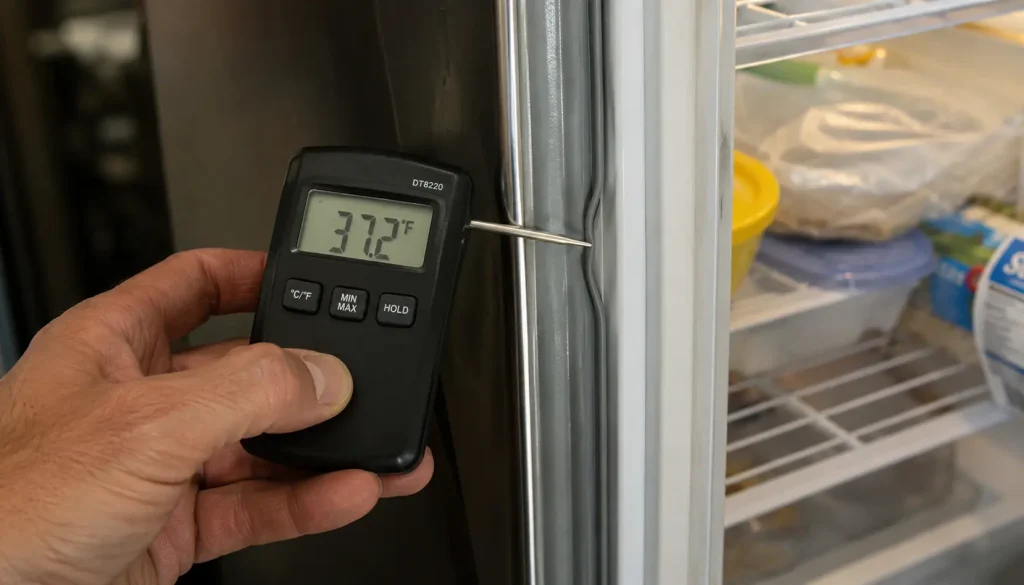
The dial number means nothing without verification. The only reliable way to know your real temperature is an appliance thermometer placed inside the unit, not the built in digital display alone, since displays can drift out of accuracy over time.
Steps to check accurately:
- Place a reliable appliance thermometer in a glass of water on the middle shelf of the refrigerator
- Place a second thermometer directly on a shelf in the freezer, not touching frozen food
- Leave both in place for a full 24 hours without adjusting the dial
- Check the reading without opening the door right before, since opening skews results
- Record the temperature and compare it to the 40°F and 0°F targets
- Adjust the dial in small increments if the reading is off, then wait another 24 hours before checking again
Thermometer Placement and Calibration
Placement matters more than most people expect. A thermometer stuck in the door shelf will always read warmer than the true internal temperature, because the door area is the least insulated and most exposed to incoming warm air every time it opens.
Best placement practices:
- Middle shelf, center of the compartment, for the most representative reading
- Away from vents that blow cold air directly onto the thermometer, which reads artificially low
- Separate readings for the meat drawer if you store items that need to stay closer to 34°F
- Freezer thermometer placed among frozen goods, not resting against the back wall where frost buildup can throw off readings
To calibrate a thermometer, submerge it in a glass of ice water for a few minutes. It should read 32°F. If it reads noticeably higher or lower, account for that offset when reading your fridge and freezer temperatures.
Why Refrigerator Temperature Fluctuates
Some fluctuation is completely normal. Every refrigerator cycles the compressor on and off rather than running constantly, so temperature naturally drifts a few degrees within each cycle. Door openings, adding warm leftovers, and restocking groceries all cause temporary spikes that resolve within an hour or two as the compressor catches up.
What is not normal is a fridge that never recovers back to 40°F or below between cycles, or one that swings by more than 5 to 7 degrees repeatedly throughout the day. That pattern points to something beyond normal use, which we cover further down.
How Often to Check Temperature During Extreme Texas Heat
During the hottest stretch of Texas summer, typically June through September, check your refrigerator and freezer temperature at least once a week rather than the occasional glance most people give it in cooler months. If you notice the compressor running almost continuously, or if outdoor temperatures spike into a multi day heat wave, check daily for a few days to catch any drift before food safety becomes a real risk.
This is also the season to pay closer attention to how your refrigerator sounds and feels. A unit that suddenly runs louder or the outside cabinet that feels unusually warm to the touch can be early signs worth tracking alongside your temperature checks.
How Temperature Affects Food Spoilage
Food safety is not just about the refrigerator setting, it is about how long food sits at unsafe temperatures. The general food safety guidance is that perishable food should not sit above 40°F for more than two hours, and that window shrinks to one hour if the ambient temperature is above 90°F, which is common during a Texas summer power outage or an overloaded, poorly ventilated fridge.
| Situation | Food Safety Guidance |
| Fridge temporarily above 40°F for under 2 hours | Generally safe, refrigerate promptly once corrected |
| Fridge above 40°F for more than 2 hours | Discard perishable items to avoid illness risk |
| Power outage with fridge closed | Food stays safe for about 4 hours if door remains shut |
| Freezer during power outage | A full freezer holds safe temperature about 48 hours if unopened, a half full freezer about 24 hours |
These figures come from food safety guidance published by the USDA and FoodSafety.gov, and they are worth bookmarking for any extended Texas summer outage.
Energy Saving Temperature Tips
You do not need to sacrifice food safety to save on your electric bill. A few adjustments reduce strain without pushing temperatures into unsafe territory.
- Keep the refrigerator at 37°F to 40°F rather than colder than necessary
- Keep the freezer at 0°F, not several degrees below unless manufacturer guidance says otherwise
- Let hot leftovers cool briefly on the counter before placing them inside, since a large hot dish forces the compressor to work harder to recover
- Keep the unit reasonably full but not packed, since a moderately stocked fridge holds temperature more efficiently than an empty one, but an overstuffed one blocks airflow
- Clean condenser coils every few months, more often if you have pets
- Check and replace worn door seals, since a small air leak forces constant recompression
- Give the unit a few inches of clearance on all sides for proper airflow
- Avoid placing the refrigerator near a stove, dishwasher, or in direct window sunlight
ENERGY STAR guidance notes that a poorly maintained or inefficient refrigerator can be one of the larger ongoing electricity draws in a home, so these small maintenance habits compound over a hot Texas summer.
Door Opening, Overloading, and Airflow Mistakes
Three habits quietly undo good temperature settings no matter how carefully you dial them in.
Standing with the door open while deciding what to eat. Every extra second the door stays open lets warm, humid Texas air pour in, and the compressor has to run longer to recover.
Overloading the shelves. Cold air needs to circulate around every item. A refrigerator packed wall to wall traps warm pockets of air near the back or corners, even while the front items feel cold.
Blocking the vents. Most refrigerators have internal vents that distribute cold air from the freezer or the cooling unit into the fridge compartment. Storing tall items directly in front of these vents creates uneven cooling and forces the thermostat to overcompensate elsewhere.
Ice Buildup and Frost Issues
Frost accumulating on the back interior wall of the freezer, around the door seal, or on food packaging is usually a sign of excess humidity entering the unit, often from a door seal that no longer closes tightly. In Texas humidity, especially in coastal or Gulf adjacent regions, this problem shows up faster than in drier climates.
Excess frost buildup reduces usable freezer space, blocks airflow around the evaporator fan, and can eventually cause the whole compartment to cool unevenly. If you notice frost accumulating quickly after a fresh defrost, or ice forming in patterns that suggest a seal is failing, it is worth a physical inspection of the gasket for cracks, gaps, or stiffness.
When Temperature Problems Indicate a Refrigerator Fault
Not every warm reading is a Texas heat issue you can fix with better habits. Some patterns point directly to a mechanical or electrical fault:
- Temperature stays above 40°F even after 24 hours of an undisturbed, correctly set dial
- The compressor runs constantly and never cycles off
- One compartment cools fine while the other does not
- Unusual noises like grinding, buzzing, or clicking that were not there before
- Warm spots on the outer cabinet beyond what is normal for the condenser area
- Water pooling inside or underneath the unit
- Frost forming rapidly right after a manual defrost
These symptoms often trace back to a failing thermostat, a weak evaporator fan, a refrigerant issue, or a compressor nearing the end of its service life. Our refrigerator repair service page walks through the most common causes we see in Abilene area homes during peak summer months.
If your fridge is showing more than just a temperature problem, we have covered other common refrigerator issues Abilene, TX homeowners run into. Read our guide on how to fix a leaking refrigerator water dispenser if you are also dealing with water pooling near the ice maker, or check our full breakdown on why your refrigerator is not cooling, which covers every cause we see across Abilene homes once summer temperatures push past 95°F.
When to Call a Professional
Some fixes are safe for any homeowner to handle, cleaning coils, adjusting the dial, checking the seal for visible gaps, or rearranging shelves for better airflow. Others require a trained technician, especially anything involving refrigerant, electrical components, or a sealed system repair.
Call a professional if:
- Temperature has stayed unsafe for more than 24 hours despite correct settings
- You hear grinding or unusual mechanical noise
- The compressor never shuts off
- You suspect a refrigerant leak, often noticeable as an odd chemical smell or oily residue near the compressor
- The unit is under warranty, since DIY repairs can void coverage
If your refrigerator is showing any of these signs, our team at Abilene Appliance Experts handles refrigerator diagnostics and repair for homes across the region. Reach out through our contact page to schedule a visit.
Frequently Asked Questions
What is the ideal temperature for a refrigerator?
The refrigerator should stay at or below 40°F, with 37°F often cited as an ideal target that leaves a small safety margin.
What is the ideal temperature for a freezer?
The freezer should stay at 0°F or below to fully stop bacterial growth and preserve food texture over time.
Why is my refrigerator not cold enough in summer?
Hot ambient air, dirty condenser coils, a worn door seal, overloading, or a unit placed in direct sunlight or a hot garage can all reduce cooling efficiency during Texas summer heat.
Can extreme Texas heat damage my refrigerator?
Sustained high ambient temperatures put extra strain on the compressor and can shorten its lifespan over time, especially if airflow around the unit is already restricted.
How long can food stay safe if my fridge stops cooling during a power outage?
A closed refrigerator generally keeps food safe for about 4 hours. A full freezer holds safe temperature for about 48 hours, a half full freezer for about 24 hours, as long as the door stays shut.
Should I keep my refrigerator colder in summer to compensate for heat?
No. Setting it colder than 37°F to 40°F wastes energy and does not meaningfully protect against a real cooling problem. It is better to verify the actual temperature and check for maintenance issues like dirty coils or a bad seal.
Why does my freezer have frost buildup even though it is a frost free model?
Frost buildup even on frost free models usually points to a door seal that is not closing properly, letting humid air in continuously, which is worth inspecting closely in humid Texas conditions.
Is it normal for the refrigerator temperature to change throughout the day?
Small fluctuations from compressor cycling, door openings, and adding new groceries are normal. Consistent readings above 40°F that never recover point to a real problem.
Final Thoughts
Getting your refrigerator and freezer temperature right is one of the simplest, most overlooked ways to protect your family’s food and your utility bill at the same time, especially once Texas heat pushes your appliance to its limits. A cheap thermometer, a quick coil cleaning, and a five minute seal check can solve most of what feels like a mystery problem. When the issue goes beyond a setting adjustment, our technicians at Abilene Appliance Experts are ready to diagnose and repair refrigerators across Abilene and nearby communities including Wylie, Tye, Lytle, and Buffalo Gap.