

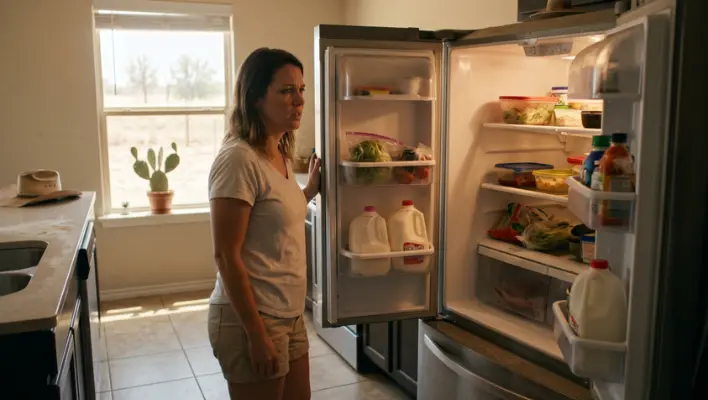
Your refrigerator stopped cooling. In Abilene, TX, that is not a small problem. With summer temperatures pushing past 95°F and West Texas dust getting into everything, a warm fridge can go from inconvenient to a full food-safety emergency within hours.
This guide covers every reason your refrigerator may have stopped cooling, how to diagnose each one, what the fix looks like, and when to call a professional. It is written specifically for Abilene homeowners dealing with Taylor County’s heat, hard water, and dust.
Why Abilene Makes Refrigerator Problems Worse
Most refrigerator guides are written for average conditions. Abilene is not average.
Three local factors accelerate refrigerator wear more than most people realize:
Extreme heat
Summer highs regularly exceed 95°F, and days above 101°F are not rare. Your compressor has to work far harder just to hold a safe 37°F inside the cabinet. The longer it strains, the faster it wears out.
West Texas dust
Abilene’s dust coats condenser coils faster than almost anywhere else in the country. Coated coils cannot release heat, which forces the compressor to run constantly and overheat over time.
Hard water
The water supply in Taylor County is mineral-heavy. That mineral buildup collects inside ice maker lines, water inlet valves, and defrost drain tubes, causing clogs and failures that homeowners in other cities rarely deal with.
Residents near Dyess AFB, in Wylie, North Abilene, and out toward Tuscola all face these same pressures every summer. Knowing this helps you find the problem faster and prevent it from coming back.
How Your Refrigerator Actually Cools Food
You do not need an engineering degree to understand this, but knowing the basics makes diagnosing problems much easier.
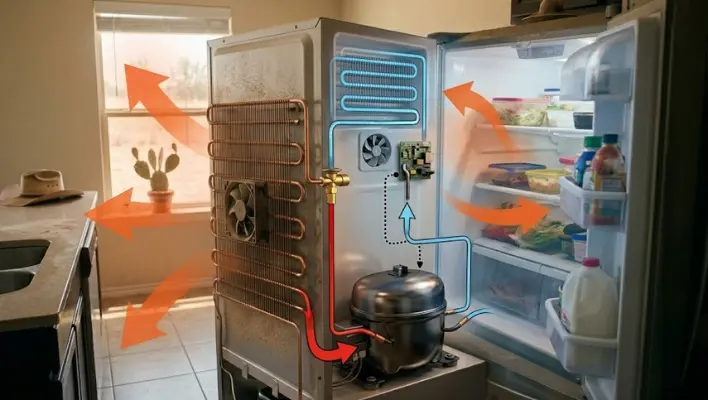
Your refrigerator does not make cold air. It removes heat from inside the cabinet and dumps it into your kitchen. Here is how that happens:
The Compressor
The compressor is the engine. It pressurizes refrigerant gas, raising its temperature, and pushes it through the system. No compressor means no cooling.
The Condenser Coils
Hot refrigerant gas flows into the condenser coils, located underneath or behind the unit. Heat radiates out into your kitchen here. A condenser fan helps pull air over the coils. The refrigerant cools and turns into a liquid.
The Expansion Device
The liquid refrigerant passes through an expansion valve, which rapidly drops its pressure and temperature. This prepares it to absorb heat inside the cabinet.
The Evaporator Coils
Now cold, the refrigerant flows through evaporator coils inside the freezer compartment. These coils absorb heat from the interior air. An evaporator fan circulates that cooled air through both the freezer and the fresh food section.
The Thermostat and Thermistor
The thermostat tells the compressor when to turn on and off. The thermistor reads the actual interior temperature and reports back to the control board. Together they keep everything regulated.
When any one of these stages fails, cooling suffers. In Abilene’s environment, several stages can be stressed at once.
Warning Signs Your Refrigerator Is Losing Cooling Ability
Cooling failures rarely happen without warning. Catch these early and you may avoid a bigger repair:
Food spoiling faster than normal is usually the first sign. Milk going bad a day before its date, meat turning slick ahead of schedule.
Soft or partially melted ice cream tells you your freezer temperature has risen above the safe range.
The compressor running nonstop without cycling off means it is working overtime to compensate for a problem somewhere in the system.
Clicking sounds every few minutes from the back of the unit is the signature of a compressor trying to start but failing, usually because of a bad start relay.
Squealing or chirping from the freezer compartment almost always points to a failing evaporator fan motor.
Frost or ice covering the back panel inside the freezer is a clear sign of defrost system failure.
A sudden spike in your electric bill without an obvious cause can mean your refrigerator is drawing excessive power trying to cool itself.
Condensation on the outside of the cabinet during summer can indicate door gaskets are failing and warm air is constantly leaking in.
Causes of a Refrigerator Not Cooling
1. Dirty or Clogged Condenser Coils
This is the single most common and most preventable cause of refrigerator cooling failure, and in Abilene it happens faster than anywhere else.
The condenser coils release heat from the refrigerant into the air around them. When they are coated in dust, pet hair, and grease, they cannot do that job. The compressor runs continuously and the refrigerator never reaches the right temperature.
Where they are: Underneath the unit behind the front kick plate grille on most modern refrigerators, or on the back of older models.
How to diagnose it: Pull the refrigerator out and shine a flashlight at the coils. A grey or tan coating of fuzz confirms the problem.
The fix: Vacuum the coils with a brush attachment, then finish with a flexible coil cleaning brush. Do not use water near electrical components.
Abilene maintenance tip: Standard advice is to clean coils every six months. In Abilene, every three months is more realistic. If you have pets, check monthly.
Cost: Free as a DIY task. Usually included in a professional diagnostic visit.
2. Faulty Evaporator Fan Motor
If your freezer is cold but the refrigerator section is warm, this is the most likely cause.
The evaporator fan circulates cold air from the evaporator coils through vents into the fresh food compartment. When it stops, cold air stays trapped in the freezer and the fridge side warms up.
How to diagnose it: Close both doors and listen. You should hear a faint hum from the freezer. If you hear squealing or chirping, or nothing at all, the fan is failing. Remove the back panel inside the freezer and try spinning the blade by hand after unplugging. If it is stiff or will not turn, the motor has seized.
Also check the door switch that shuts the fan off when a door opens. If it is stuck, the fan will never run.
The fix: Replace the evaporator fan motor. This is a manageable DIY repair once the freezer back panel is removed.
Important: If the coils behind the panel are completely encased in frost, do not assume the fan is dead. The frost may be physically blocking the blade. That points to defrost system failure instead. Never chip at the ice with a sharp object as this can puncture the coil tubing.
Typical cost: $130 to $300 with professional labor.
3. Condenser Fan Motor Failure
The condenser fan is separate from the evaporator fan. It sits at the back of the refrigerator near the compressor and helps pull air over the condenser coils to dissipate heat.
When this fan fails, heat cannot escape the sealed system. The compressor overheats, efficiency drops, and eventually cooling fails entirely. Left unaddressed long enough, an overheated compressor can be permanently damaged.
Note that refrigerators with coils mounted on the back exterior do not have a condenser fan. They rely on passive airflow instead.
How to diagnose it: Unplug the refrigerator and remove the rear access panel near the bottom. Try spinning the condenser fan blade. It should turn freely. If it is stiff or does not spin, replace the motor. If it spins freely, test the motor windings with a multimeter for continuity.
Also look for debris around the blades. In Abilene, West Texas cotton and dust can physically obstruct the blade without any motor failure at all.
The fix: Replace the condenser fan motor. Parts are widely available and model-specific.
Typical cost: $120 to $250 with professional labor.
4. Bad Start Relay or Compressor Failure
These two issues share symptoms but have very different repair costs, so telling them apart matters.
The start relay is a small, inexpensive component plugged into the side of the compressor. It gives the compressor motor the initial jolt of current it needs to start each cycle. When it fails, you hear clicking from the back of the refrigerator every few minutes as the compressor tries and fails to start.
How to test the start relay: Unplug the refrigerator, pull the relay off the compressor, and shake it near your ear. A rattle means it has failed and needs replacement. This is one of the easiest and most affordable refrigerator repairs possible, typically taking fifteen minutes.
Compressor failure is a different situation. If replacing the start relay does not restore cooling, or if the compressor makes grinding or knocking sounds, the compressor itself may have failed. This is caused by electrical faults, mechanical wear, or overheating from extended hard running, which is especially relevant during Abilene summers.
Testing the compressor properly requires manifold gauges and a multimeter. This is professional territory.
Cost of start relay replacement: $30 to $100 total.
Cost of compressor replacement: $400 to $700 or more.
On an older refrigerator, this cost often makes replacement a smarter choice than repair.
5. Defrost System Failure
This one is deceptive because the compressor still runs and everything sounds normal, but the refrigerator slowly stops cooling.
Modern refrigerators run an automatic defrost cycle every 8 to 12 hours that briefly heats the evaporator coils to melt any accumulated frost. Three components make this happen: the defrost heater, the defrost thermostat, and the defrost timer or control board.
When any of these fails, frost builds up unchecked on the evaporator coils. Over days and weeks it becomes a solid block of ice that completely stops airflow. The fan may be physically blocked. The coils cannot cool the air. Temperatures inside climb even though the compressor is humming away normally.
How to diagnose it: Remove the freezer back panel. If the evaporator coils are covered in thick frost or solid ice, defrost failure is the cause.
Finding the specific failed component: Manually defrost the unit by unplugging it for 24 to 48 hours with towels on the floor. If cooling returns but the problem comes back within days or weeks, use a multimeter to test the defrost heater for continuity, test the defrost thermostat while it is cold, and manually advance the defrost timer with a screwdriver to see if the heater activates. Whichever component fails its test needs replacement.
Typical cost: $150 to $350 with professional labor, depending on which component failed.
6. Thermostat or Thermistor Problems
The temperature control thermostat directs electrical power to the compressor, evaporator fan, and condenser fan. When it fails, these components may not receive power at all, causing the entire system to sit idle while temperatures inside climb.
How to diagnose a bad thermostat: Turn the control to its coldest setting and listen for a click. No click suggests the thermostat contacts have failed. Confirm by testing continuity with a multimeter at the coldest setting.
On modern refrigerators, the thermistor replaces the mechanical thermostat as the temperature sensor. It sends resistance readings to the electronic control board. A faulty thermistor sends incorrect data, so the board makes wrong decisions, such as never starting the compressor when the fridge is actually warm.
Testing the thermistor involves submerging its tip in ice water and checking resistance values against manufacturer specifications. It is an affordable part to replace when confirmed faulty.
If both thermostat and thermistor test fine but the refrigerator still misbehaves, the main electronic control board itself may have failed. Board diagnosis and replacement require professional expertise.
Typical cost: Thermostat replacement $100 to $300. Thermistor replacement $100 to $200. Control board replacement $200 to $600.
7. Clogged Defrost Drain Tube
Even when the defrost system is working properly, the meltwater it produces needs somewhere to go. It drains through a tube beneath the evaporator coils down into a drain pan under the refrigerator, where it evaporates.
When that tube gets clogged, meltwater backs up and refreezes on the coils and surrounding surfaces. The result looks identical to a defrost system failure but the cause is a simple blockage. In Abilene, the mineral scale from hard water is a frequent culprit, coating the inside of the drain tube over time.
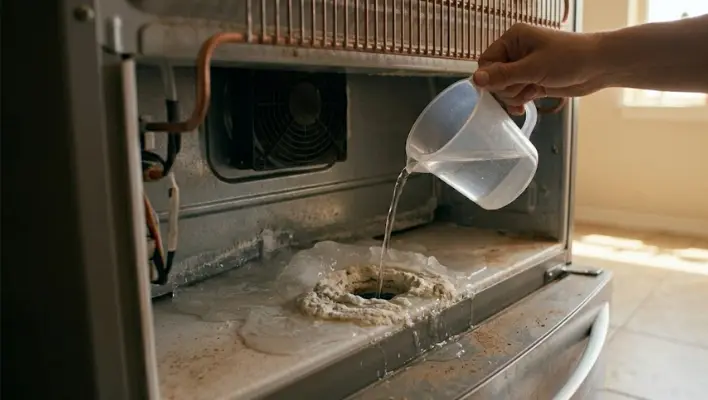
How to diagnose it: After manually defrosting the unit, locate the drain hole beneath the evaporator coil assembly and pour a small amount of warm water into it. If the water does not drain freely, the tube is clogged.
The fix: Use a small flexible brush or a turkey baster with warm water to flush the clog clear. For recurring mineral buildup, periodically flush the drain tube with a mild warm water and white vinegar solution. This is especially relevant for Taylor County homes dealing with hard water.
Typical cost: Free as a DIY task. Around $100 to $200 if a technician handles it as part of a service visit.
8. Worn or Damaged Door Gaskets
The rubber magnetic seal around your refrigerator and freezer doors is your first line of defense against warm air. In Abilene’s summer heat, even a small gap in the seal has an outsized impact because the temperature difference between your kitchen and the interior of the refrigerator is so extreme.
A compromised gasket means the compressor never truly gets to rest. It runs and runs to compensate for the constant warm air seeping in, wearing itself out in the process. A $30 gasket problem left unaddressed can become a $500 compressor problem.
How to diagnose it: Close the refrigerator door on a piece of paper. If you can pull it out with no resistance, the seal has failed at that point. Test all the way around both doors. Also look for visible cracks, tears, mold growth, or flattened sections that no longer spring back when pressed.
The fix: Clean gaskets with warm soapy water first. Grease and food residue prevent a good seal even when the gasket is structurally intact. If the gasket is cracked or deformed, replace it. Soak the new gasket in warm water before installation to make it pliable and easier to seat evenly in the door channel.
Typical cost: $100 to $250 with professional labor.
9. Refrigerant Leak in the Sealed System
Refrigerant is what physically carries heat out of your refrigerator. When the sealed system develops a leak, the refrigerant level drops, cooling capacity falls gradually, and eventually the refrigerator stops cooling entirely.
Signs of a refrigerant leak: The refrigerator runs continuously without reaching temperature and the decline is gradual over days or weeks rather than sudden. You may notice an oily residue near the compressor or along tubing at the back of the unit. Unlike defrost failures, a refrigerant-low refrigerator will show clean evaporator coils with little to no frost, because there is not enough pressure for the coils to get cold enough to form it.
The fix: This requires an EPA Section 608 certified technician without exception. Federal law prohibits venting refrigerants. A professional will locate and repair the leak, pull a vacuum on the system, and recharge it to the correct pressure.
If the leak is at a corroded evaporator coil, coil replacement may also be required. On an older refrigerator, the total cost of sealed system work can approach the price of a replacement unit and deserves a frank conversation about repair versus replacement.
Typical cost: $200 to $600 or more depending on the location and severity of the leak.
10. Blocked Internal Airflow
Sometimes nothing is broken. Cold air simply cannot get where it needs to go.
Inside the refrigerator, cold air flows from the freezer through a damper into the fresh food compartment, circulates around the food, absorbs heat, and returns to the evaporator coils. Overpacking shelves, pushing items against vents, or stacking food in ways that block circulation can warm the interior significantly without any component failure.
This is especially common in Abilene households during summer when families stock up to reduce how often they go out in the heat.
The air damper: A small flap between the freezer and fresh food sections controls cold air flow between the two compartments. If it is stuck closed due to ice buildup or mechanical failure, the refrigerator section will warm even though the freezer is perfectly fine.
The fix: Reorganize the refrigerator to leave at least one inch of clearance around interior vents and walls. Check that the damper moves freely. If it is frozen in place, a manual defrost will clear it.
Typical cost: Zero. This is a user-correction, not a repair.
11. Power Supply and Electrical Issues
Before suspecting any component, confirm your refrigerator is receiving stable power.
Check that the plug is fully seated in the outlet. A loose connection can cause the control board to reset repeatedly. Test the outlet by plugging in another device. Check your circuit breaker panel for a tripped breaker and reset it by switching fully to off before turning it back on.
Power surges during Abilene thunderstorms can damage the electronic control board or other electrical components. If your cooling problem began shortly after a storm or notable power event, a surge may be responsible.
Voltage irregularities can also prevent the compressor from starting properly. A standard refrigerator circuit should read between 115 and 120 volts. A licensed electrician can verify this if you suspect a wiring issue.
12. Incorrect Temperature Settings
This is the simplest cause and more common than most people expect.
The temperature control can be bumped accidentally, particularly on models with the controls inside the cabinet. Someone reaching for something on the top shelf can shift the dial without realizing it.
Your refrigerator should hold 35 to 38°F. The freezer should hold 0 to 5°F. Use a standalone appliance thermometer rather than relying on the built-in display, which reads a sensor rather than the average cabinet temperature.
Also confirm the refrigerator is not placed too close to a wall, next to an oven or dishwasher, or in a hot garage. These placement issues force the unit to work dramatically harder to maintain temperature.
Freezer Is Cold but Refrigerator Is Warm? Here Is What That Means
This specific symptom is one of the most common calls we receive from Abilene homeowners and it narrows the diagnosis considerably.
Failed evaporator fan motor
This the leading cause. Cold air cannot move from the freezer into the fresh food section. Listen for the fan when doors are closed and check whether the blade spins freely.
Stuck or iced-over air damper
It is the second most common cause. If the damper between the two compartments is frozen shut, cold air is blocked from crossing over. Check the damper at the top of the refrigerator compartment near the back.
Blocked vents
From overpacked shelves blocked vents prevent cold air from distributing properly even when the fan and damper are both working. Rearrange the contents and check vent clearance before pursuing any mechanical repair.
Step-by-Step Troubleshooting Sequence
Work through this in order rather than randomly replacing parts.
Step 1: Verify power is stable and temperature settings are correct. Use an appliance thermometer to confirm actual temperatures.
Step 2: Clean the condenser coils. In Abilene this alone solves a meaningful percentage of cooling complaints.
Step 3: Check all door gaskets using the paper test. Clean them first, then inspect for physical damage.
Step 4: Check internal airflow and confirm the air damper moves freely.
Step 5: Listen to the compressor at the back of the unit. Steady hum means it is running. Clicking every few minutes means the start relay has likely failed.
Step 6: Inspect the evaporator fan. Remove the freezer back panel and check for ice-covered coils or a seized fan blade.
Step 7: If coils were iced over, manually defrost the unit and test the defrost heater, thermostat, and timer with a multimeter to identify the failed component.
Step 8: Test the thermostat and thermistor if the cooling system appears to be running but temperature regulation is off.
Step 9: Call a professional for anything involving the sealed refrigerant system, the compressor, control board, or any issue that has not been resolved by the steps above.
What Does Refrigerator Repair Cost in Abilene?
| Repair | Typical Cost |
| Diagnostic service call | $60 to $100 (credited toward repair) |
| Start relay replacement | $30 to $100 |
| Door gasket replacement | $100 to $250 |
| Evaporator fan motor | $130 to $300 |
| Condenser fan motor | $120 to $250 |
| Defrost component replacement | $150 to $350 |
| Thermostat or thermistor | $100 to $300 |
| Electronic control board | $200 to $600 |
| Compressor replacement | $400 to $700+ |
| Sealed system refrigerant repair | $200 to $600+ |
The average refrigerator repair falls between $300 and $500, which is significantly less than replacing the unit. The average new full-size refrigerator costs $1,000 to $2,000.
Repair or Replace? How to Decide
Use the 50/50 rule that most appliance professionals follow: if your refrigerator is more than halfway through its expected lifespan and the repair cost exceeds 50% of what a comparable new unit costs, replacement is usually the smarter financial move.
Average refrigerator lifespan by type:
Standard top-freezer models: 14 to 17 years.
Bottom-freezer models: up to 13 years.
Side-by-side models: around 10 years.
Built-in refrigerators: up to 20 years with proper care.
Compact or mini fridges: 6 to 9 years.
Repair is almost always worth it on units under 8 years old with a single failed component. Replacement deserves serious consideration on units over 10 years old facing compressor or sealed system work.
Also factor in energy efficiency. Refrigerators manufactured before 2014 use significantly more electricity than current ENERGY STAR models. In Abilene where refrigerators run harder through summer, the savings from a new efficient unit add up.
Common Brands in Abilene Homes and Their Known Weak Points
Whirlpool and Maytag
Most common brands in Taylor County. Known for reliable sealed systems but susceptible to defrost thermostat failure and evaporator fan wear on units from 2010 to 2016.
LG French door models
From 2014 to 2019 have a well-documented linear compressor failure issue that resulted in class action litigation. If you own one of these and it has stopped cooling, start with the compressor.
Samsung
Frequently develops ice maker failures from hard water buildup in the water inlet valve and fill tubes, which is a particular issue given Abilene’s mineral-heavy water supply.
GE and GE Profile
Models are generally reliable but commonly develop defrost heater failures and thermistor issues as they age past ten years.
Frigidaire
Models frequently show evaporator fan motor wear and start relay failures in older units.
Kenmore
Refrigerators vary widely because they are manufactured by different companies depending on the model. The first three digits of the model number identify the actual manufacturer.
Refrigerator Maintenance Schedule for Abilene Homeowners
Prevention beats repair every time, especially in a West Texas climate that accelerates wear on every component.
Every month: Wipe door gaskets with warm soapy water. If you have pets, check and clean condenser coils.
Every three months: Clean condenser coils thoroughly. Check actual temperatures with an appliance thermometer. Inspect the drain pan below the unit.
Every six months: Listen to the evaporator fan for unusual noise. Flush the defrost drain tube with warm water to prevent mineral scale buildup. Check that the refrigerator is level so doors seal properly.
Every year: Have a technician inspect the sealed system, check refrigerant pressure, and evaluate the overall condition of major components. Particularly important once the unit reaches 8 years old.
After any major power event: Check temperatures and listen for unusual sounds from the compressor or fans.
Food Safety During a Cooling Failure
A warm refrigerator is a food safety issue, not just an appliance problem.
The FDA recommends keeping refrigerator temperatures at or below 40°F. Above that threshold, bacteria multiply rapidly. If your refrigerator has been above 40°F for more than two hours, evaluate all perishables carefully. Meat, poultry, seafood, dairy, eggs, cooked leftovers, and anything containing mayonnaise are the highest-risk items. When in doubt, throw it out.
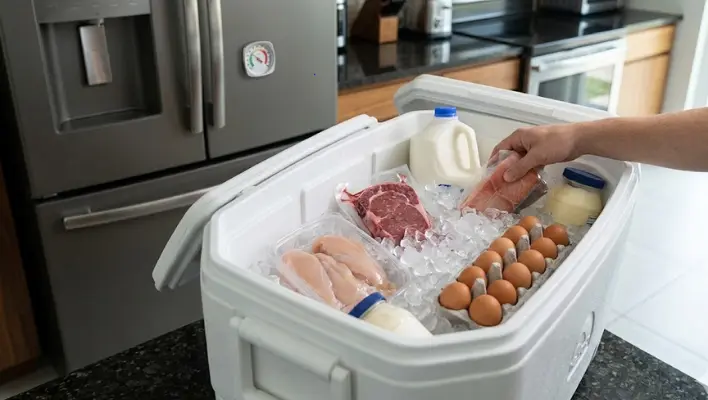
Keep doors closed as much as possible during a failure. A full freezer maintains safe temperature for approximately 48 hours if left undisturbed. The refrigerator section stays safe for only about four hours once cooling stops.
A quality cooler with ice or dry ice will protect food safely while repairs are being made.
When to Call a Professional in Abilene
Call a technician when:
The problem involves refrigerant or the sealed system in any way. You have worked through all the steps above and the cause is still unclear. The defrost issue keeps returning after manual resets. The control board appears to be faulty based on erratic or unexplainable behavior. The compressor is making grinding, rattling, or abnormally loud noises. You are not comfortable removing internal panels or working near electrical components.
A qualified Abilene appliance repair technician brings proper diagnostic equipment, model-specific experience, and access to quality parts. For anything beyond basic cleaning and straightforward component swaps, professional service is almost always the right call.
Protect Your Food and Your Appliance
A refrigerator that stops cooling in Abilene, TX, deserves a fast and thorough response. The combination of extreme summer heat, West Texas dust, and hard water means that small problems escalate quickly here compared to other parts of the country.
Start with the simple checks. Clean the coils, test the gaskets, inspect the evaporator fan. Many cooling problems are solved without a single replacement part. For anything deeper, the team at Abilene Appliance Experts is ready to diagnose and fix the issue correctly the first time, keeping your groceries safe and your appliance running through whatever West Texas summer throws at it.
Is your refrigerator not cooling in Abilene, TX? Contact Abilene Appliance Experts for fast, professional diagnosis and same-day service when available.